Community Artists
Interviews, Poems, and Stories from Local Artists
Richard Beyer
Who is Richard Beyer?
Richard Beyer was a sculptor whose works can be found throughout the Pacific Northwest. He sculptedThe Man Who Used to Hunt Cougars for Bounty for Western Washington University’s campus in 1972. In his artist statement for this piece, found in Sarah Clark-Langager’s Sculpture in Place: A Campus as Site, Beyer shared his belief that public art is necessary for a community to flourish; as such, he thought of his own work as a “social service”. His sculptures often feature human and animal symbols as representations of community.
The The Man Who Used to Hunt Cougars for Bounty is based on a Bellingham folktale about a man who spent his life hunting cougars on Sehome Hill. After losing his ability to hunt in his old age, he and a cougar reconciled in a “drunken haze,” embracing and sharing a bottle of whiskey. The sculpture depicts the cougar sitting on the man’s lap, with the bottle of whiskey sitting on the ground behind them. Beyer, assisted by his son, son-in-law, and a friend, spent three months carving the sculpture from a granite block. The sculpture was previously situated near the north entrance to Wilson Library facing Old Main Lawn. The university switched the sculpture with David Ireland’s Bigger Big Chair and relocated it to the woods near Fairhaven College in September 2024.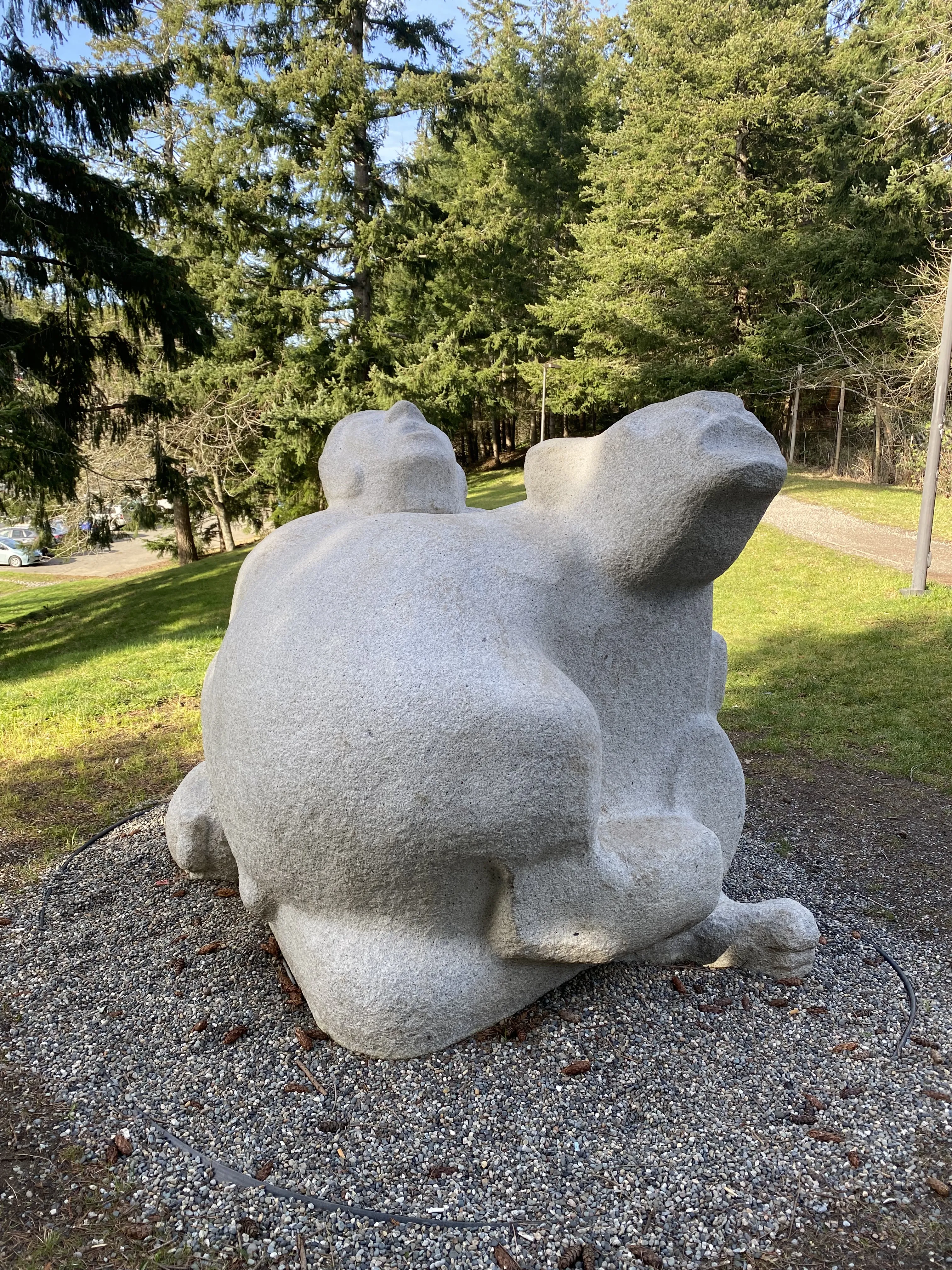
The Man Who Used to Hunt Cougars for Bounty on the Fairhaven ridge trail.
To read more student work about Beyer and The Man Who Used to Hunt Cougars for Bounty, check out this detailed page, which features short essays and artwork.
Sam Chapman
Sam Chapman and the North West (NW) Woods Collection
Sam Chapman is a local artist who spent 17 years living and working on Whidbey Island before moving to Bellingham. Chapman works with several mediums, including acrylic, gouache, pastels, and mixed media combinations. His NW Woods collection features oil pastel pieces depicting trails and forests in the Bellingham area, including Sehome Hill.
Reflecting on the NW Woods collection, Chapman says:
"Depending on the season and light, the NW woods can be calm, colorful or threatening and dangerous. Hiking along the trail, I am surrounded by trees full of mottled light, mossy and silent.
I love working on paper because of its intimacy. It is soft, flexible, durable, and draws you in. I believe that when drawing is at its best; the process is visible. Whether thick or thin, the stroke of oil pastel is visual. You can see and feel the mark and what the artist did to create it. This series of working outside shows my love for the North West woods, and a desire to be lost in its light, sky, color and trees.”
Chapman’s Sehome Hill (2022) is an oil pastel drawing of trees on the hill:
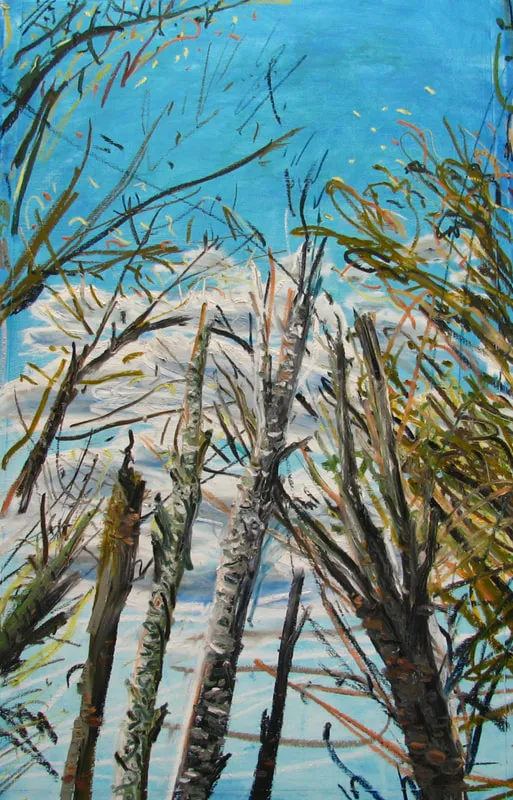
Sehome Hill (2022)
Explore more of Sam Chapman’s artwork, including the rest of the NW Woods collectionvisit his website.
tElla Higginson
Who is Ella Higginson?
Transcript:
Laura Laffrado:
This is Laura Laffrado, Professor of English at Western Washington University. I’m going to give a brief introduction to Pacific Northwest author, Ella Higginson.
At the turn of the twentieth century, Ella Higginson was the most famous author from the Pacific Northwest in the world. She had won multiple national awards, her books were extremely popular, her poems were sung by major dramatic singers of the day, her work appeared in periodicals and magazines and books in the United States and around the globe. Ella Higginson lived on Sehome Hill and the house that she and her husband had built there was one of the first houses on Sehome Hill. And this was before, what is now Western Washington University, had even been thought of.
The house that they built on Sehome Hill meant that Higginson was able to ride her horse daily and take her dog with her all through the forests on Sehome Hill which had not been logged at that point. Ella Higginson never went to church, instead though she was a very religious woman, she said that she would go to Sehome Hill in the woods and walk around and there she would feel closest to God.
How did Sehome Hill inspire Ella Higginson?
Transcript:
Laura Laffrado:
This is Laura Laffrado. I’m a Professor at Western Washington University and I’m gonna talk about how Pacific Northwest author, Ella Higginson, was so able to admire and be familiar with and write about Sehome Hill. Ella Higginson’s house was built on Sehome Hill, where Viking Commons, part of Western Washington University now stands.
Her house was three stories high. It was 400 feet above sea level and so her windows, her Bay windows, looked right out on Puget Sound. At the other side of her house, her windows looked right out on Sehome Hill. And for the longest time there weren’t any other buildings or houses there. And even when the building that is now known as Old Main is first constructed, it is the sole building on campus for quite a few years. So Ella Higginson pretty much, no matter where she was in her beautiful house, could look out over Puget Sound or could walk to the other end of her house and look out at Sehome hill.
The reason that Pacific Northwest author, Ella Higginson, is important when we think about the history of Sehome Hill, is because, not only did she live on Sehome Hill, but she is the only person who wrote about Sehome Hill in a very literary fashion in many of her poems and in many of her prose works. So when Ella Higginson writes about Sehome Hill, we can see the various stages that Sehome Hill goes through.
She writes about the beauty of Sehome Hill before there are many homes on it. She writes about Sehome Hill before Western Washington University even exists. She writes about Sehome Hill when Settler Colonialists are setting the trees on fire on Sehome Hill at night, and burning all the trees down so that they could clear more land.
We know in the twenty-first century that these things happened on Sehome Hill. But it is only through Ella Higginson’s writing that we can actually see the history of Sehome Hill, stage by stage, and watch as it becomes a different part of a different community as time goes on.
Click to listen to the poems that Ella Higginson was inspired by Sehome Hill
Introduction to "A White Night"
Transcript:
Laura Laffrado:
This is Laura Laffrado. I’m a professor at Western Washington University, and I’ll be introducing the poem, “A White Night,” by Pacific Northwest author Ella Higginson.
Ella Higginson often walked during the day and during the night on Sehome Hill. And one night she was walking on Sehome Hill and she was so enjoying the smells and the sounds and the beauty of Sehome Hill at night. And she knew that when she looked out her window out at Puget Sound, she could see the beauty of Puget Sound. And she thought that this was all so overwhelmingly gorgeous that not even the dead could sleep through an experience like this. And this is the poem that she wrote.
"A White Night"
Transcript:
Laura Laffrado:
This is Laura Laffrado, Professor of English at Western Washington University. I’m going to read a poem called, “A White Night” by Pacific Northwest author, Ella Higginson.
A White Night.
The moon burns on the brow of Sehome hill,
The hour is late, the night is still;
Wild clover-stars shine everywhere—
Their breath spills on the blue-white air.
I think you know that one long, mournful cry
Blown by some bird throat, full and high;
Is it a note of tender woes?
Or lonely joy? . . . . Who knows—who knows?
I hear the hurried panting of the mill;
One cricket pipes; all else is still,—
Nay, what lone fluter have we here?
The last frog by the reeded mere.
What does he murmur of, think you, in sleep?
Those long blown notes, drowsy and deep—
Do they not hold a dream of days Idled in long-forgotten Mays?
Below, the sea lies blue and still and fair,
With stars set in her tawny hair;
Within the curled arms of her waves
The dead awaken from their graves,
And reach their yearning arms and strain their eyes,
Wondering if their dreams were lies,
And these the arms and palms and mouth
Of one loved in the far sweet South.
For how, I ask you, can the dead lie still
When moons came over Sehome hill,
And languid winds blow from the South . . . .
And kisses wait on every mouth?
Introduction to "Midnight on Brooklyn Bridge"
Transcript:
Laura Laffrado:
This is Laura Laffrado. I’m a professor at Western Washington University, and I’m going to be introducing the poem, “Midnight on Brooklyn Bridge” by Pacific Northwest author Ella Higginson.
Ella Higginson traveled by train with her husband across the entire United States from the Pacific Northwest to the Northeastern United States so that Ella could meet the extended family of her very distinguished husband.
While they were on this trip, they visited New York City, and went to see Brooklyn Bridge, a very notable landmark. And at Brooklyn Bridge, Ella became overwhelmed with the heat and the noise, and the energy of the larger city, so different from the then remote, small town that she lived in the Pacific Northwest. She became homesick thinking about the moon rising over Sehome Hill and she wrote this poem.
"Midnight on Brooklyn Bridge
Transcript:
Laura Laffrado:
This is Laura Laffrado, Professor of English at Western Washington University. I’m going to read a poem called, “Midnight on Brooklyn Bridge” by Pacific Northwest author, Ella Higginson.
Midnight on Brooklyn Bridge.
Ah, me! I know how large and cool and white
The moon lies on the brow of Sehome Hill,
And how the firs stand shadowy and still,
Etched on that luminous background this soft night;
How the nighthawk sinks from his starry height,
And breathes his one note, mournfully and shrill,
And crickets clamor in the marsh until
The dusk grows vocal with their deep delight.
City, a lifetime spent in thee were not
Worth one night in my western solitude!
Thy pulse is feverish, thy blood is hot,
Thine arteries throb with passion heavily;
But oh, how sweet I hear, in interlude,
The beating, moon-lured tides of Puget Sea.
Introduction to "To One Leaving for Sweden"
Transcript:
Laura Laffrado:
This is Laura Laffrado. I’m a professor at Western Washington University, and I’ll be introducing the poem, “To One Leaving for Sweden,” by Pacific Northwest author Ella Higginson.
At the turn into the twentieth century, one of Ella Higginson’s very close female friends was about to leave on a trip for Sweden and Ella knew how she would miss her friend when she was gone. How she would look at her window at night watching the moon rising over Sehome Hill and be terribly lonely. And this was the poem she wrote about that experience.
"To One Leaving for Sweden"
Transcript:
Laura Laffrado:
This is Laura Laffrado, I’m a Professor at Western Washington University and I’m going to read a poem called, “To One Leaving for Sweden” by Pacific Northwest author, Ella Higginson.
To One Leaving for Sweden.
When soft and deep in Sweden’s skies
Moons burn like golden fire,
And the nightingale thrills all the wood
With exquisite desire,
Turn, turn upon thy pillow then,
And think how dark and still
The firs wait for the rising moon
On lonely Sehome hill.
Turn from thy song-bird’s ravishment—
And think how mournfully
The night-hawk blows its lonely note
By Puget’s lonely sea.
Introduction to "The Awakening"
Transcript:
Laura Laffrado:
This is Laura Laffrado. I’m a professor at Western Washington University, and I’m going to be introducing the poem, “The Awakening,” by Ella Higginson
By the beginning of the twentieth century, Ella Higginson had suffered the loss of several very close family members. Her father, her mother, and then her husband had died and she was sunk into grief. During the spring she was walking on Sehome Hill, watching everything start to come to life again. And she prayed to God that she too, could be reborn like the nature around her on Sehome Hill. And this is the poem that she wrote about that experience.
"The Awakening"
Transcript:
Laura Laffrado:
This is Laura Laffrado, Professor of English at Western Washington University. I’m going to read a poem called, “The Awakening” by Pacific Northwest author, Ella Higginson.
The Awakening.
I will take heart again; the spring
Comes over Sehome hill,
And like tall, splintered spears of gold
The firs stand, soft and still;
Happily in its moist, brown throat
Chatters a loosened rill.
Below, across the violet sea,
With glistening, restless wings,
The seabirds cleave the purple air
In white and endless rings;
Somewhere, within an open space,
One of God’s own larks sings.
The warm breath of the waking earth
Curls up from myriad lips,
And who has loved and lost now drinks
In deep and trembling sips,
With memory’s passionate pulse astir
From heart to finger-tips.
The ferns lift delicate veiny palms
In dimples of the hills,
The spendthrift hyacinth’s perfume
Along the pure air spills;
There is a breathing, faint and far,
From the dark throats of the mills.
The spider flings a glittering thread
From dewy blade to blade,
A robin drops on bended wing,
Near me, yet unafraid;
The early frosts have taken rout
Before the red sun’s raid.
Behold, the earth is glad again,
And she has taken heart,
And in her swelling, fruitful breast,
God’s own love-flowers start.
(Lord, may I not take courage, too?
I and my old self part?)
Yea, when the birds grow dumb again
With pure delights that thrill
Their rapt and innocent souls, till they
Have not desire or will
For song, or sun, or anything
But passion deep and still,
I will go into the dim wood
And lie prone on the sod,
My breast close to the warm earth-breast,
Prostrate, alone with God,
Of all his poor and useless ones,
The poorest, useless clod;
And I will pray (so earnestly
He cannot help but hear):
“Lord, Lord, let me take heart again,
Let my faith shine white and clear,
Let me awaken with the earth,
And leave my old self here!”
"Four-Leaf Clover"
Transcript:
Laura Laffrado:
This is Laura Laffrado, Professor of English at Western Washington University. I’m going to read Pacific Northwest author Ella Higginson’s most famous poem, “Four-Leaf Clover”.
I know a place where the sun is like gold
And cherry blossoms burst with snow,
And down underneath is the loveliest nook,
Where the four-leaf clovers grow.
One leaf is for hope, and one for faith
And one is for love, you know,
And God put another one in for luck-
If you search, you will find where they grow.
But you must have hope, and you must have faith,
You must love and be strong and so-
If you work, if you wait you will find the place
Where the four leaf clovers grow.
More about Ella Higginson
Click to learn about the Ella Higginson Recovery Project on the Ella Higginson Website